



Osteopathy, Posture
how can I improve my posture?

Jan
A very common question is: how can I improve my posture? You have that forward head position, the hump at the base of the spine, and a line across your abdomen where you’ve been slouching. Welcome to the sitting trend. But the question is: how can I improve my posture—or is it too late?
For a lot of us, it’s the simple, consistent strategies that make the most difference. I remember training to become an Osteopath, and my colleagues would tell me how bent over my spine was. I felt conscious and started trying to…
- Sit up taller — but my lower back started to ache
- Push my shoulders back — but then my head would look even more forward
- Create a double chin — but that just didn’t feel right
What started to realistically help my posture was when I asked myself “Why” I am in this position in the first place. Based on those answers, I could come up with a plan to help myself. Let’s go through this journey together; it might help you too.
Why number 1: If I am sitting very long, gravity squishes me down.
If I’ve been sitting for 8–9 hours a day, gravity is pushing down on me all day. Gravitational force is constant and strong! In fact, think of gravity as a heavy book on a marshmallow. Your skeletal system is like the marshmallow, moulding based on the force it’s under. If you’ve been sitting for a long period of time, the body gradually shifts into a bent back, forward head posture, and tight hips.
Simple strategy:
Time to push upwards against gravity. What if you could reduce the constant pressure of the book on the head? Maybe your body will mould differently. If you consistently stand up, reach above your head, or even do some hanging, you won’t allow your posture to sink and squish.
Put a timer on every hour to move upwards against gravity. Remember: consistency is everything.
Why number 2: Am I really breathing properly?
When we’re in these dysfunctional postures, it really affects our ability to breathe. The diaphragm (which sits under your rib cage) struggles to expand, and we end up using the secondary breathing muscles around the shoulders and neck.
Simple strategy:
Now we need to open up the space between our lower ribs and pelvis — but not just upwards. Try reaching overhead into side bending or adding rotational reaches with the hands. Remember to take nice deep breaths as you move, and slow long out-breaths as you return back to the centre.
Once again, consistency is key. A daily movement snack like this can really help unwind stuck postures.
The magic of asking why.
The key takeaway here is simple: instead of hoping for a quick posture fix related to your chair or a posture strap, ask yourself why your body might have chosen this posture.
If we can use this method for other problems we’re facing, it might help give clues to the strategies we can use to help ourselves.
My posture has improved a lot since understanding these two basic “why’s” and practising consistently. Slow and steady brings progress; quick returns might feel good but rarely last long.
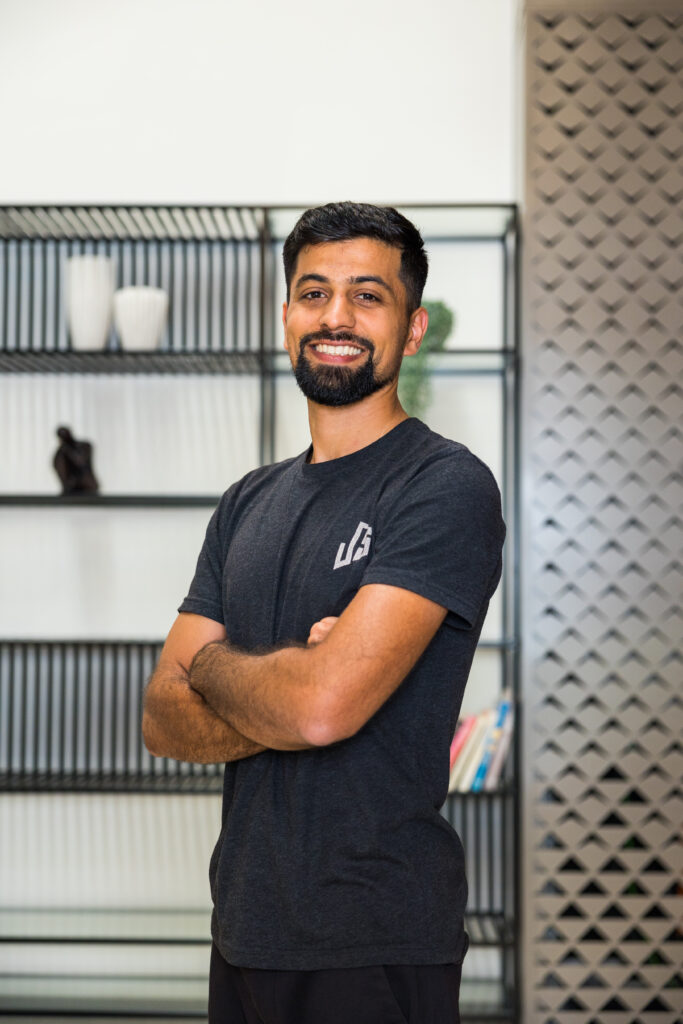
Zain Panjwani
Osteopath
Osteopath, Naturopath & Lifestyle Medicine practitioner Zainali has been practicing for over 9 years. His interest and love for sports initially took him into elite athletics dealing with some of the UK’s top 100m Sprinters & Long Jumpers. He founded his own clinic in the UK where he treated a variety of people from sports to chronic pain and autoimmune conditions.
The knowledge he has built up has allowed him to assess and treat according to your functional goals and abilities, utilising active movement therapy. 3D movement assessments and functional exercises. Zainali is an accredited Golf Performance Specialist from the Gray Institute (USA). This unique approach has enabled him to assist golfers in their mobility and stability as it relates to golf biomechanics.
Most recently, he has embarked on the Institute of Functional Medicine programme beginning with the AFMCP course. This avenue has broadened his understanding of the integrated systems of our human body. It has deepened his Osteopathic treatment to be able to address chronic disease and pain using nutrition and lifestyle changes. Zainali continues to learn, teach and educate himself in order to better serve others.